



שאלה טכנית
-
MAYDASSA
- מתקין

- הודעות: 6092
- הצטרף: 28 מאי 2005, 11:03


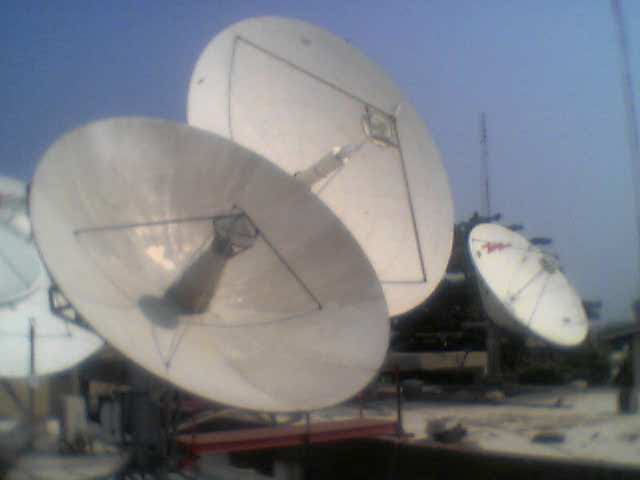
זה הכל תלוי כמה רוחב פס יש לשידור , כמה ערוצים רוצים להעביר , כמה הספק שידור יש לתחנת השידור , איזה גודל אנטנה יש בצד המשדר ואיזה גודל אנטנה יש בצד הקולט .
הנה הסבר באנגלית מצורף :
Symbol Rate
This page refers to the outlink multi-Mbit/s carrier from the hub which is shared amongst all vsat users to download internet web pages etc. The carrier is similar to a DVB-S carrier which carries several MPEG TV programmes.
The carrier on the satellite is made up of a sequence of joined together pulses to make a continuous signal. Each pulse is a symbol. According to the modulation method each symbol represents 1, 2 or 3 etc bits of transmission rate data.
In phase shift keying (PSK) modulation each pulse is a burst of carrier signal with its sinewave zero crossing point timing adjusted forwards or backwards in time to constitute a phase shift. Phase shifts of 180 deg apply in BPSK, 90 deg in QPSK etc. A phase shift of 90 deg represents a time shift of 1/4 of a full cycle of the sinewave. The closer the spacing phase shifts, the more difficult it is to distinguish between them at the receive end, so for for each higher order PSK schemes more carrier to noise ratio is required.
As a general rule if you have bandwidth to spare, then use a lower order modulation or a higher rate FEC (like 1/2 or 2/3) to spread the signal out. If you have power to spare then use a higher order modulation and/or lower rate FEC (like 3/4 ot 7/8). Ideally you want to use all of both the available bandwidth and power simultaneously to obtain the highest user information rate.
If you use larger receive dishes you will always be able to increase the system capacity. If you are doing a point to point link it is worth using larger dishes - spend more on the antennas and save on the space segment costs. If you have thousands of receive dishes then the aggregate cost of these is significant and you will want to allow smaller receive dish sizes even though this reduces system capacity and increases space segment costs.
הנה הסבר באנגלית מצורף :
Symbol Rate
This page refers to the outlink multi-Mbit/s carrier from the hub which is shared amongst all vsat users to download internet web pages etc. The carrier is similar to a DVB-S carrier which carries several MPEG TV programmes.
The carrier on the satellite is made up of a sequence of joined together pulses to make a continuous signal. Each pulse is a symbol. According to the modulation method each symbol represents 1, 2 or 3 etc bits of transmission rate data.
In phase shift keying (PSK) modulation each pulse is a burst of carrier signal with its sinewave zero crossing point timing adjusted forwards or backwards in time to constitute a phase shift. Phase shifts of 180 deg apply in BPSK, 90 deg in QPSK etc. A phase shift of 90 deg represents a time shift of 1/4 of a full cycle of the sinewave. The closer the spacing phase shifts, the more difficult it is to distinguish between them at the receive end, so for for each higher order PSK schemes more carrier to noise ratio is required.
As a general rule if you have bandwidth to spare, then use a lower order modulation or a higher rate FEC (like 1/2 or 2/3) to spread the signal out. If you have power to spare then use a higher order modulation and/or lower rate FEC (like 3/4 ot 7/8). Ideally you want to use all of both the available bandwidth and power simultaneously to obtain the highest user information rate.
If you use larger receive dishes you will always be able to increase the system capacity. If you are doing a point to point link it is worth using larger dishes - spend more on the antennas and save on the space segment costs. If you have thousands of receive dishes then the aggregate cost of these is significant and you will want to allow smaller receive dish sizes even though this reduces system capacity and increases space segment costs.
ההמשך לגבי ה FEC -
Forward error correction
Forward error correction is applied to the customer's information data at the transmit end.
so transmission data rate = customer information rate x 1/ (FEC rate).
FEC rate is typically in the range 1/2 to 7/8 so the transmission data rate is always significantly more than the customer information rate.
This page provides a key formula:
SR = Symbol Rate
DR = Data Rate = the customer information rate.
CRv = Viterbi forward error correction (FEC) Code Rate. Eg. 1/2, 2/3, 3/4, 5/6, 7/8
CRrs = Reed Soloman forward error correction (FEC) Code Rate. Eg. 188/204
m = modulation factor (transmission rate bits per symbol). BPSK=1, QPSK=2, 8PSK=3 etc
Formula: SR = DR / (m x CRv x CRrs)
Forward error correction
Forward error correction is applied to the customer's information data at the transmit end.
so transmission data rate = customer information rate x 1/ (FEC rate).
FEC rate is typically in the range 1/2 to 7/8 so the transmission data rate is always significantly more than the customer information rate.
This page provides a key formula:
SR = Symbol Rate
DR = Data Rate = the customer information rate.
CRv = Viterbi forward error correction (FEC) Code Rate. Eg. 1/2, 2/3, 3/4, 5/6, 7/8
CRrs = Reed Soloman forward error correction (FEC) Code Rate. Eg. 188/204
m = modulation factor (transmission rate bits per symbol). BPSK=1, QPSK=2, 8PSK=3 etc
Formula: SR = DR / (m x CRv x CRrs)